| Dawn of time |
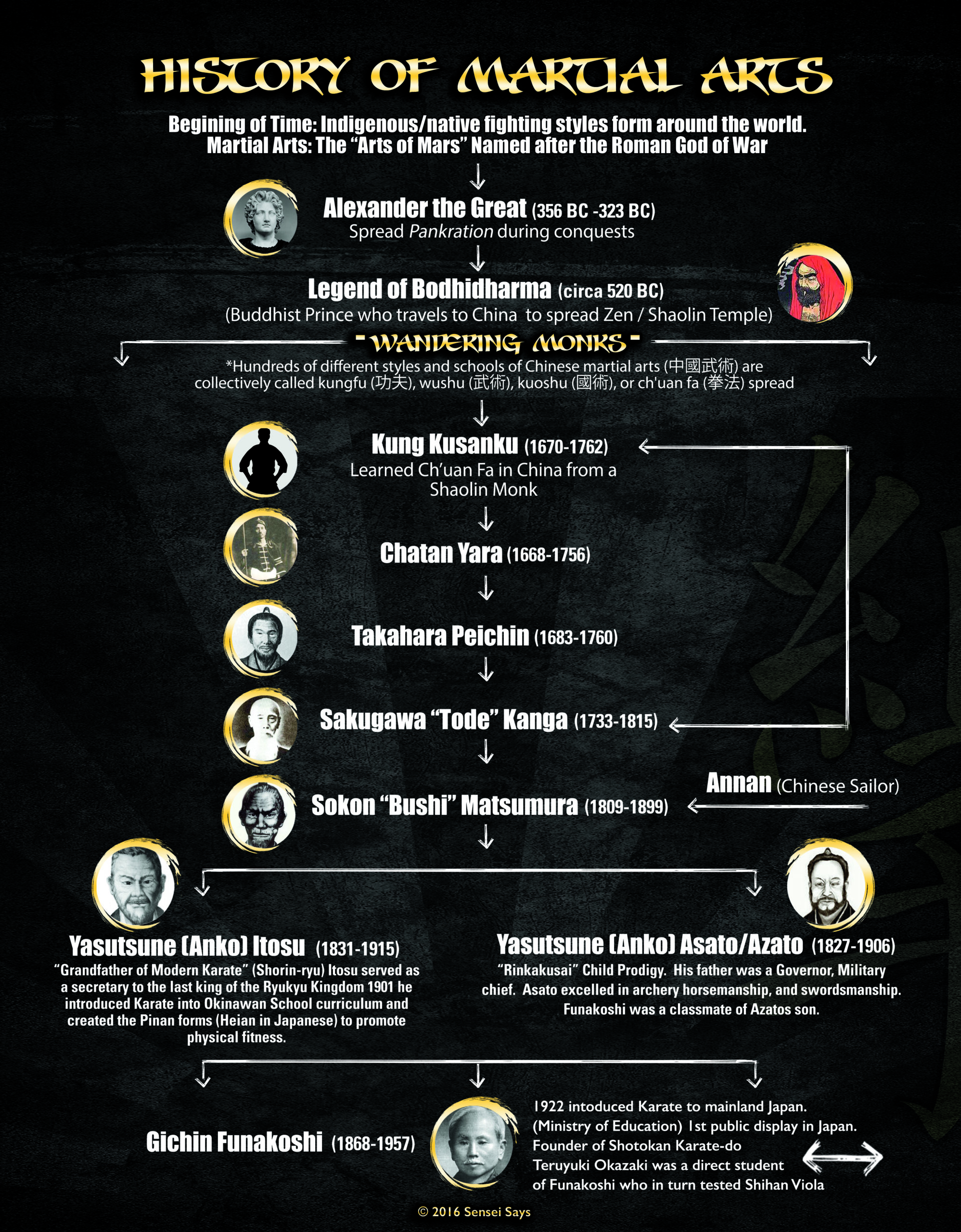
Native fighting systems emerge around the world |
| 336–323 BC |
Alexander the Great conquers and spreads martial arts, including Greek pankration, throughout the world, including India |
| circa 550 |
Indian prince Bodhidharma spreads Buddhism to China. Folklore links him to the Shaolin monks and the birth of kung fu (Chinese kenpo) |
| 1156 |
Samurai class emerges; the Bushido “warrior” code is born |
| circa 1372 |
Okinawa begins trade relations with China, introducing foreign fighting systems such as Chinese kenpo to the Ryukyu Islands |
| 1470 |
Okinawan King Shō Shin bans swords in Okinawa; kobudō develops |
| 1609 |
Okinawa is conquered by the Shimazu Clan. Weapons are banned, and underground secret fighting arts develop |
| circa 1800 |
Matsumura “Bushi” Sōkon is born. A student of Kanga Sakukawa, he would later teach masters Itosu and Asato |
| 1868 |
Gichin Funakoshi is born |
| 1879 |
Funakoshi learns “tōde” (Tang/China Hand), sometimes called Okinawa-te, under Asato and Itosu |
| 1882 |
Jigoro Kano modifies traditional Japanese jujutsu to develop judo |
| 1889 |
Funakoshi becomes a schoolteacher in Okinawa |
| 1891 |
As early as 1891, the Japanese army showed interest in Okinawan “te,” but it was considered too disorganized and lacking standards. Itosu would later modernize karate |
| 1895 |
Dai Nippon Butoku Kai (大日本武徳会), The Great Martial Virtues Association of Japan, is established to preserve, promote, and standardize Japanese budō traditions under Emperor Meiji and the Ministry of Education |
| 1901 |
Funakoshi and Itosu demonstrate for Shintaro Ogawa, school commissioner for Kagoshima Prefecture. Permission is granted to teach in public schools |
| 1902 |
Funakoshi and Itosu introduce tōde to the Prefectural Daiichi Middle School |
| 1905 |
Itosu introduces students to the Pinan kata, extracted from Kanku Dai, as physical education. Funakoshi would later rename them Heian |
| 1905 |
Hanashiro Chōmo publishes Karate Kumite (Shōshū Hen), the first documented text using 空 meaning “empty.” This marks part of the transition to a more Japanese Zen-based meaning |
| 1908 |
Itosu publishes Tōde Jukun, his 10 precepts explaining the benefits of karate, emphasizing health and fitness to spread karate in Okinawan schools |
| 1911 |
Dai Nippon Butoku Kai establishes the Budo Senmon Gakkō, Japan’s “West Point Academy,” mandating judo and kendo courses in all middle schools |
| 1912 |
Funakoshi becomes president of the Okinawan Shobukai (Martial Spirit Promotion Society) |
| 1915 |
Itosu dies; Funakoshi carries the torch |
| 1917 |
Funakoshi is invited by the Dai Nippon Butoku Kai to perform at the Butoku-den in Kyoto, the first demonstration of tōdi-jutsu in Japan |
| 1920 |
Mitsuyo Maeda, a student of Kano, travels to Brazil to spread judo and teaches Carlos Gracie, contributing to the birth of Brazilian jiu-jitsu |
| 1921 |
Funakoshi’s big break: he demonstrates karate for visiting Crown Prince Hirohito in the Great Hall of Shuri Castle |
| 1922 |
Shobukai is invited by the Ministry of Education to demonstrate at the All-Japan Athletic Exhibition in Tokyo. Funakoshi is selected, and the karate boom begins. Kano is in attendance |
| 1922 |
Kano invites Funakoshi to the Kodokan. Funakoshi performs Kushanku (Kanku Dai), while Makoto Gima performs Naihanchi (Tekki Shodan) |
| 1922 |
Funakoshi publishes Ryukyu Kenpo Tōde. The Shotokan tiger is created for the book cover |
| 1923 |
Funakoshi awards his first rank of 1st Dan to his assistant Makoto Gima. Dai Nippon Butokukai pushes for standards, including ranks, belts, and uniforms |
| 1924 |
First college karate club is established at Keio University |
| 1925 |
Funakoshi publishes Rentan Goshin Tōdi-jutsu (“Polish Your Courage for Self-Defense”) |
| 1928–1935 |
More than 30 karate clubs are established at Japanese universities |
| 1930 |
Shotokai (松濤會), meaning “Shoto’s Group,” is established by Funakoshi to promote karate. In 1936 it is renamed Dai Nihon Karate-do Shotokai |
| 1930s |
Political movement pushes to nationalize karate by removing Okinawan and Chinese terms; for example, Pinan becomes Heian |
| mid-1930s |
Takeshi Shimoda, one of Funakoshi’s top assistants, dies. Gigo Funakoshi assumes the role and modernizes Shotokan with lower stances and greater explosiveness |
| 1935 |
Jiyu Kumite (free sparring) is introduced |
| 1936 |
Funakoshi publishes Karate-do Kyohan (“Teaching Methods”) and uses the kanji 空 meaning “empty” instead of 唐 meaning “China/Tang” |
| FYI |
空 means “empty,” as in the philosophical concept of emptiness. It also aligns karate with Zen ideas of boundlessness and openness |
| 1939 |
First freestanding dojo opens and is named “Shotokan” |
| 1939–1945 |
World War II. Soldiers stationed in Okinawa help spread karate to America upon return. During the occupation, General MacArthur disbands the Dai Nippon Butoku Kai and other military organizations |
| 1943 |
Funakoshi publishes Karate-do Nyumon (“Introduction to Karate-do”) |
| 1945 |
Gigo Funakoshi dies |
| 1945 |
Shotokan dojo is destroyed in Allied bombing |
| 1946 |
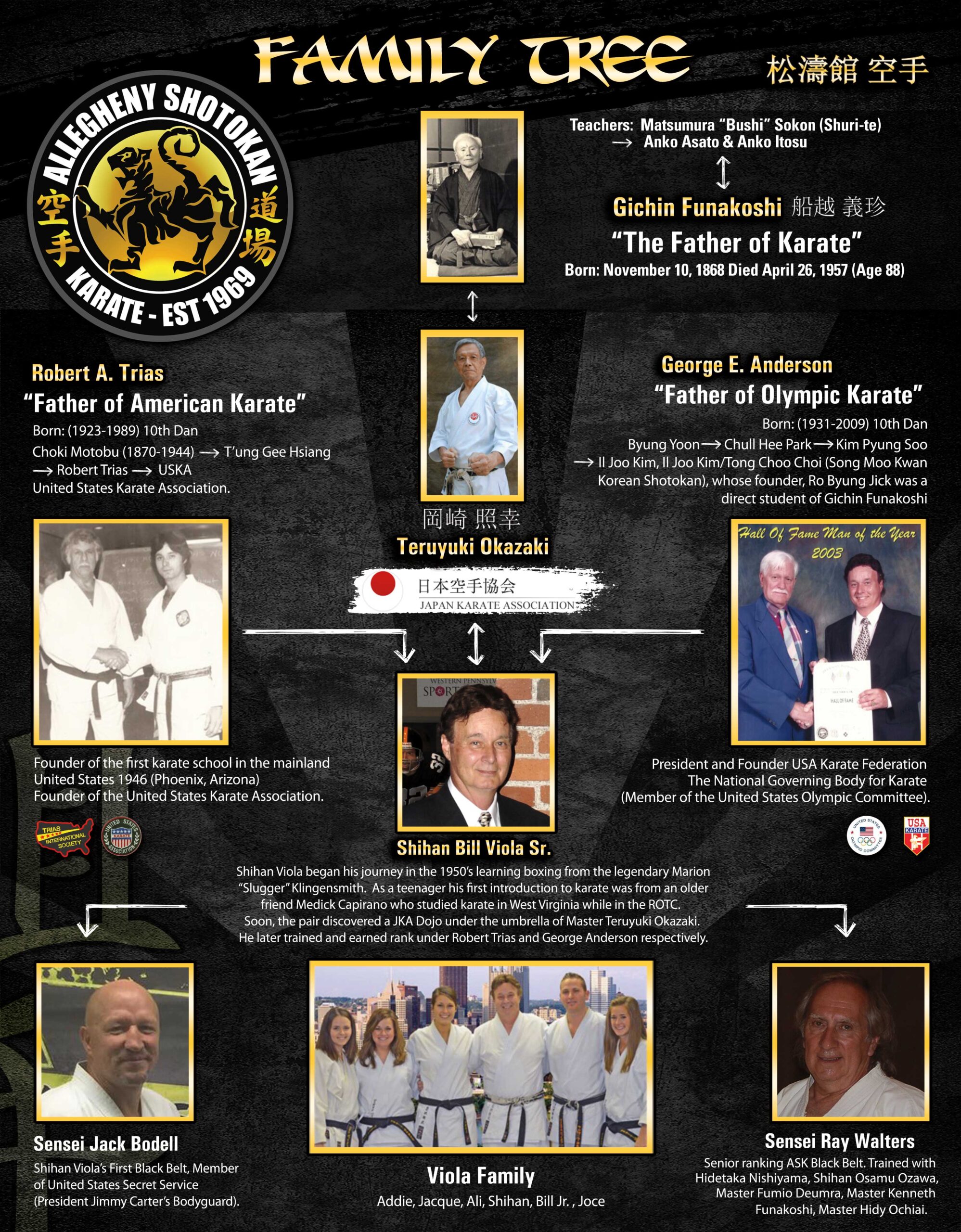
First karate school on mainland United States opens under Robert Trias (Shuri-ryu) |
| 1948 |
United States Karate Association (USKA) is founded by Robert Trias |
| 1949 |
Nihon Karate Kyokai (JKA) is organized under Nakayama |
| 1952 |
Tsutomu Oshima creates organized rules for class sparring before tournament competition existed |
| 1953 |
Air Force Strategic Air Command General Curtis LeMay invites Nishiyama to tour American air bases and teach |
| 1953 |
Mas Oyama tours the United States, giving demonstrations of strength and power |
| 1955 |
Tsutomu Oshima attends USC. In 1957, he sets up the first university club at Caltech and is promoted to 5th Dan by Funakoshi |
| 1955 |
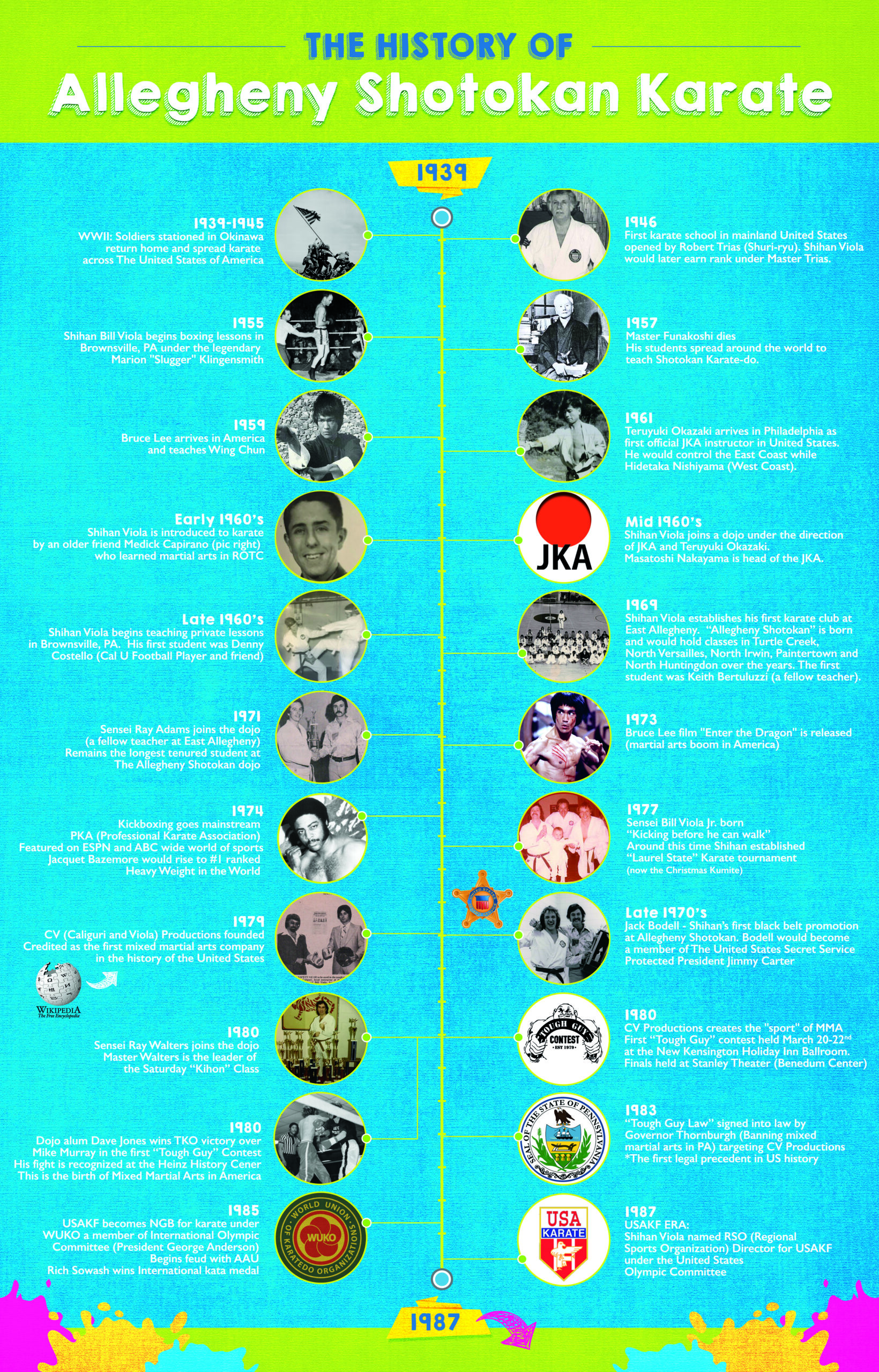
Shihan Bill Viola Sr. begins boxing lessons in Brownsville, Pennsylvania, under Marion “Slugger” Klingensmith |
| 1955 |
First karate tournament in America is hosted by Robert Trias: the 1st Arizona Karate Championships at the Butler Boys’ Club in Phoenix |
| 1956 |
Karate-do Ichiro (Karate-do, My Way of Life) is published |
| 1957 |
JKA becomes a legal entity and incorporates as an educational body under the Ministry of Education |
| 1957 |
Master Funakoshi dies |
| 1957 |
First All Japan Karate-do Championship is held in Tokyo |
| 1958 |
Oshima produces the Nisei Week Karate Championships |
| 1959 |
Bruce Lee arrives in America and teaches Wing Chun; Oshima establishes Shotokan Karate of America (SKA) |
| 1961 |
In May, Okazaki arrives in Philadelphia as the first official JKA instructor in the United States. In 1962, he sets up the East Coast Karate Association |
| 1961 |
In July, Oshima asks Nishiyama to preside over his students while he travels. Nishiyama founds AAKF and hosts the All American Karate Championships. SKA and JKA tensions begin |
| 1962 |
North American Karate Championships are held at Madison Square Garden. Highlights include a Mas Oyama demo and Gary Alexander winning sparring |
| 1963 |
1st World Karate Tournament is held at the University of Chicago by Trias and John Keehan; later connected with the USKA Grand Nationals |
| 1964 |
Ed Parker hosts the Long Beach Internationals, featuring Bruce Lee’s famous demo that helps land his Green Hornet role |
| mid-1960s |
Shihan Viola is introduced to karate by an older friend, Medick Capirano, who learned martial arts in ROTC |
| mid-1960s |
Shihan Viola joins a dojo under the direction of JKA and Okazaki through the East Coast Karate Association |
| late 1960s |
Shihan Viola begins teaching private lessons in Brownsville. His first student is Denny Costello |
| 1968 |
Jim Harrison hosts the 1st Professional Karate Tournament in Kansas City, won by Joe Lewis |
| 1969 |
Shihan Viola establishes Allegheny Shotokan Karate at East Allegheny |
| 1969 |
Keith Bertuluzzi becomes the first official Allegheny Shotokan Karate dojo student |
| 1970 |
First WUKO World Championship is held in Tokyo. WUKO later becomes WKF, which gains Olympic recognition |
| 1971 |
Sensei Ray Adams joins the dojo |
| 1973 |
Bruce Lee film Enter the Dragon is released, fueling the martial arts boom in America |
| 1974 |
Professional Karate Association is founded, helping launch kickboxing into the mainstream through TV exposure |
| 1975 |
JKA-sponsored IAKF tournament is held in the United States, eventually becoming the Shoto World Cup with ippon-shobu rules |
| 1977 |
Sensei Bill Viola Jr. is born |
| 1979 |
CV (Caliguri and Viola) Productions is founded, regarded as the first mixed martial arts company in America |
| late 1970s |
Jack Bodell earns the first black belt at Allegheny Shotokan |
| 1980 |
Sensei Ray Walters joins the dojo |
| 1980 |
CV Productions invents the Tough Guy Contest, the first mixed martial arts competition and league in America |
| 1980 |
Dave Jones defeats Mike Murray by TKO in the first mixed martial arts championships in the United States |
| 1981 |
At the 5th WUKO World Championships, Tokey Hill wins America’s first gold medal in kumite; Billy Blanks wins silver |
| 1983 |
The Tough Guy Law is signed by Governor Thornburgh, banning mixed martial arts in Pennsylvania and creating the first legal precedent in U.S. history |
| 1985 |
USA Karate Federation (USAKF) becomes the national governing body for karate under WUKO |
| 1985 |
Nishiyama establishes ITKF and begins a feud with WUKO |
| 1987 |
Shihan Viola is named Regional Sports Organization Director for USAKF under the United States Olympic Committee |
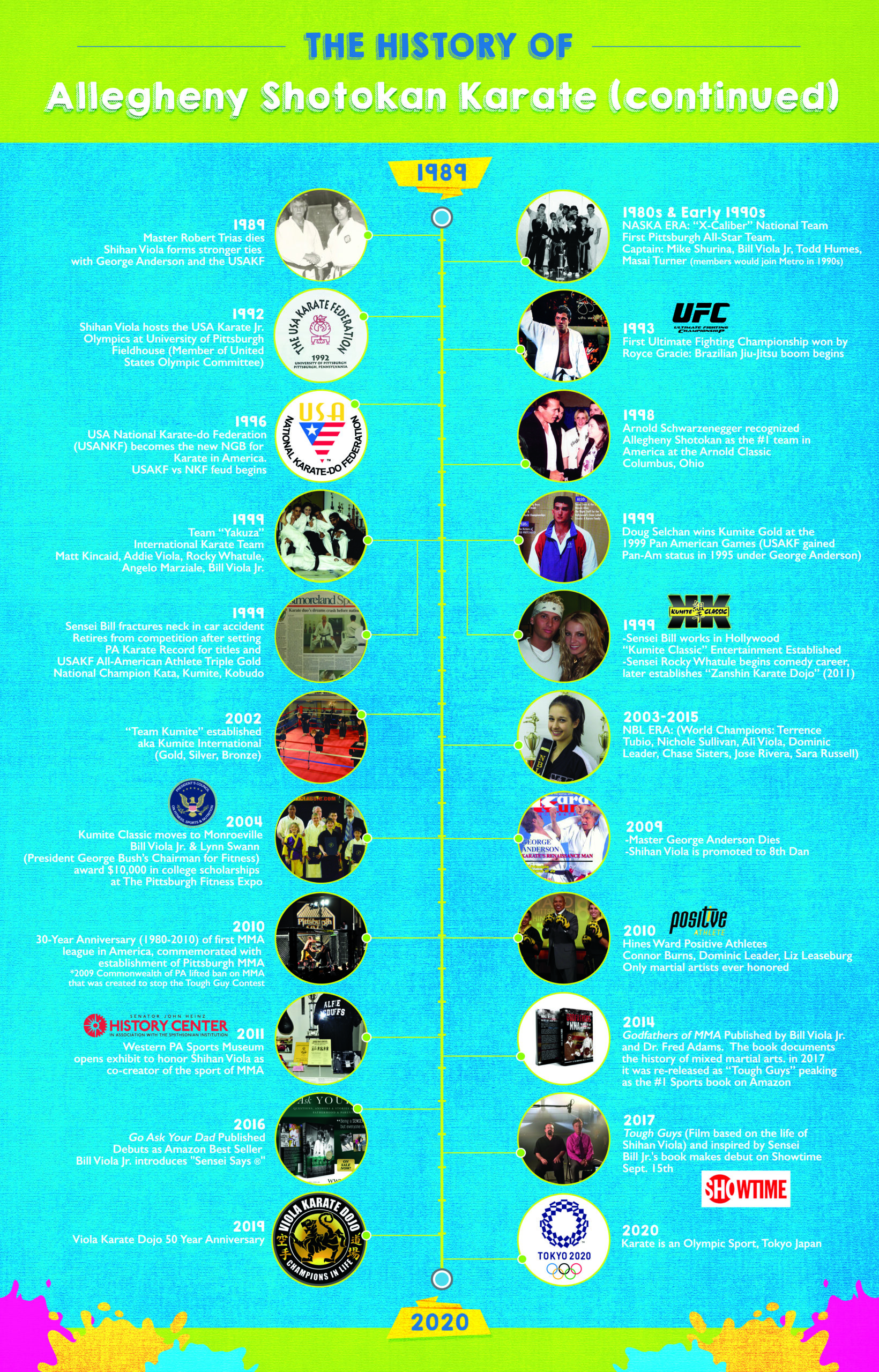
| 1989 |
Robert Trias dies |
| 1990 |
|